Showing posts with label CO2. Show all posts

Coffee Cup Conundrum


I lose coffee cups. I lose travel mugs. At work I used to walk with the mug; set it somewhere; retrieve it weeks later only when stumbled upon. I have left them at coffee shops. I have buried them in the backyard. As such, I was in the market this week for a new travel mug.

Here's the mess I got into: What is my real carbon footprint by buying mug A, B, or C here around town?  


I thought, surely, the Thermos company from Illinois is a safe bet. Well, Shopko ships these mugs in from China. 

OK, then Cuisenart out of New York sounded promising. But Kohls receives them from China. 

Sears? The Copco brand from Illinois has them made in China, too. 

Borders? Seattle's Best mugs are made in...China.  

Aladdin, sold by REI: China.

Starbucks markets three styles- all from China.

Whole Foods offers their brand of travel mugs, made in China.  

I'm sure this is the tip of the slushy iceberg. 

Conundrum. I'm attempting to purchase a reusable cup so as not to consume a paper one. Or even the need for the coffee shop to wash their own china ware (!). Good intentions, right? BUT, the product I am attempting to buy in order to save resources has probably already used even more resources!  I'm saving a tree so it can do it's job of absorbing CO2, but end up consuming fossil fuels and emitting transportation CO2 in the process!


I'm not going to try to extrapolate figures into carbon tons, but the fact is that after the mug is produced in Beijing, it and its little buddies must travel, as the crow flies, 10,400 miles to Madison. I might as well use a cup made from recycled paper that comes from a sustainable forest in northern Wisconsin!


Check your coffee mugs. We're chasing our tails! 

A little searching on the net revealed some nice looking ceramic travel mugs, made in the USA. This seems to be the best answer at this point. Sounds like a lot less energy and resource usage, and I think I can handle not dropping it...

[Don't even get started on the transportation resource costs of beautiful reusable water bottles that keep us from using the dastardly disposable bottles with questionable water quality. We are so screwed in these drinking container cycles.]


Electric Cars: Advertised As Emission Free?

Take a step back and think this through...

There's a manufactured consumer war between oil and coal energies.  Who'da thunk we'd arrive within this realm of advertising? There are currently commercials that pit internal combustion engines against electricity. Which one is creating the most carbon pollution? Careful.

Here's a car commercial. Amusing scenario - the array of appliances and tools that are normally clean electric are, instead, run by internal combustion engines.


And so, the clean little Nissan LEAF is unplugged and ready for a clean drive because the extension chord does not create exhaust. (Did you catch the dig on the Chevy Volt; a hybrid?) 

Otherwise, it's black smoke and fumes. This is what gasoline combustion spews, right? Yes, but what is the unspoken implication here about electricity? Clean?

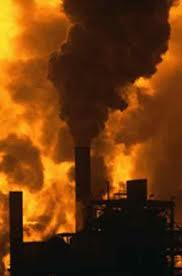
Picture a coal-fired electric generation plant. We've seen the stacks in the distance. Black plumes on the horizon. The question is, then: Is gasoline combustion better, or coal combustion better?  

When you plug ANYTHING into your wall socket, including an electric car, it is likely being generated by coal, or by a withering nuclear plant.

I'm pretty sure these commercials aren't assuming their electric cars are powered by wind generators or solar, which would be cleaner than coal. And, though wind and solar are the answer for many smaller applications, these renewables are not anywhere near a substantial resource at this point.

So, what are we ultimately talking about? Emissions? Yes. Guess what? The fossil fuel coal and the fossil fuel oil both emit crippling amounts of carbon into our biosphere. Is there even a lesser of two evils?

The play is to convince the fickle public to look at a quiet, clean, convenient, benign electrical outlet on the wall and conclude that this clean little plastic slot is producing clean energy with a little zap.

Aaaarrgh.


Bill McKibben Re: Connecting Tornado Dots

Bill McKibben

As far as I know, Bill McKibben is not known for facetious opinion. I've followed him as he has become the leading world advocate of citizen action on climate change issues. He is easy going and tireless. 


The following piece, however, needed to be written to provide another in a series of wake-up calls for us all: To allow ourselves to begin connecting the dots.

ORIGINAL ARTICLE WASHINGTON POST


A Link Between Climate Change and Joplin Tornadoes? Never!

By Bill McKibben, Published: May 23


Caution: It is vitally important not to make connections. When you see pictures of rubble like this week’s shots from Joplin, Mo., you should not wonder: Is this somehow related to the tornado outbreak three weeks ago in Tuscaloosa, Ala., or the enormous outbreak a couple of weeks before that (which, together, comprised the most active April for tornadoes in U.S. history). No, that doesn’t mean a thing.

It is far better to think of these as isolated, unpredictable, discrete events. It is not advisable to try to connect them in your mind with, say, the fires burning across Texas — fires that have burned more of America at this point this year than any wildfires have in previous years. Texas, and adjoining parts of Oklahoma and New Mexico, are drier than they’ve ever been — the drought is worse than that of the Dust Bowl. But do not wonder if they’re somehow connected.

If you did wonder, you see, you would also have to wonder about whether this year’s record snowfalls and rainfalls across the Midwest — resulting in record flooding along the Mississippi — could somehow be related. And then you might find your thoughts wandering to, oh, global warming, and to the fact that climatologists have been predicting for years that as we flood the atmosphere with carbon we will also start both drying and flooding the planet, since warm air holds more water vapor than cold air.

It’s far smarter to repeat to yourself the comforting mantra that no single weather event can ever be directly tied to climate change. There have been tornadoes before, and floods — that’s the important thing. Just be careful to make sure you don’t let yourself wonder why all these record-breaking events are happening in such proximity — that is, why there have been unprecedented megafloods in Australia, New Zealand and Pakistan in the past year. Why it’s just now that the Arctic has melted for the first time in thousands of years. No, better to focus on the immediate casualties; watch the videotape from the store cameras as the shelves are blown over. Look at the news anchorman standing in his waders in the rising river as the water approaches his chest.

Because if you asked yourself what it meant that the Amazon has just come through its second hundred-year drought in the past five years, or that the pine forests across the western part of this continent have been obliterated by a beetle in the past decade — well, you might have to ask other questions. Such as: Should President Obama really just have opened a huge swath of Wyoming to new coal mining? Should Secretary of State Hillary Clinton sign a permit this summer allowing a huge new pipeline to carry oil from the tar sands of Alberta? You might also have to ask yourself: Do we have a bigger problem than $4-a-gallon gasoline?

Better to join with the U.S. House of Representatives, which voted 240 to 184 this spring to defeat a resolution saying simply that “climate change is occurring, is caused largely by human activities, and poses significant risks for public health and welfare.” 

Propose your own physics; ignore physics altogether. Just don’t start asking yourself whether there might be some relation among last year’s failed grain harvest from the Russian heat wave, and Queensland’s failed grain harvest from its record flood, and France’s and Germany’s current drought-related crop failures, and the death of the winter wheat crop in Texas, and the inability of Midwestern farmers to get corn planted in their sodden fields. Surely the record food prices are just freak outliers, not signs of anything systemic.

It’s very important to stay calm. If you got upset about any of this, you might forget how important it is not to disrupt the record profits of our fossil fuel companies. If worst ever did come to worst, it’s reassuring to remember what the U.S. Chamber of Commerce told the Environmental Protection Agency in a recent filing: that there’s no need to worry because “populations can acclimatize to warmer climates via a range of behavioral, physiological, and technological adaptations.” I’m pretty sure that’s what residents are telling themselves in Joplin today.

Bill McKibben is founder of the global climate campaign 350.org and a distinguished scholar at Middlebury College in Vermont.


Thoughts On Population Carrying Capacity

Our current era seems to be filled with either too little or too much.  We have too much CO2. We have too little potable water. Our planet has a need for far more natural balances.  But imbalance seems to be the name of the game. 

The crux of this era’s complex puzzle may lie with people.  The number of people.  Too many.  Too many consumers.  Consumers of space, of food, of transportation, of heating and cooling, of water, of any product we need or think we need.  

Carrying capacity was generally used to assess the amount of land necessary to graze livestock.  Given X number of acres with X amount of grass, you can graze X number of animals in a sustained way.   Adding animals to this area would result in imbalance: grass would not get a chance to regerminate, trails and tracks would become rutted, erosion would carry away soil, stressed animals would compete and for ever more meager nourishment.  This is not a sustainable situation required for farming.  The farmer would need to either cut back on the herd or supplement feed and rotate animals from field to barn.  Costs in dollars and time would rise. 

All biological systems strive for a balanced carrying capacity: sustainability.  It’s not surprising, therefore, that humans must be included in this model. We’ve all seen the charts and heard the dire warnings about population numbers.   Scientist Thomas Malthus became concerned about the carrying capacity of humans on Earth way back in the 18th century. Demographers since then have been wary of the growing numbers of our species and its ability to be sustained.  

Malthus couldn't have conceived how the timeline for population "overshoot" might extend itself. He could not have envisioned the extent of developing industrialization.   The 19th and 20th century would encourage cultures to assume the carrying capacity of Earth could be expanded.  And it was expanded, artificially, with the help of oil.  Oil-run industry was able to promote a limitless sense of a modern lifestyle.  It promoted growth.  "Growth was good."  Those of Earth’s cultures who were able, jumped on the evolving growth bandwagon.

“Growth for the sake of growth is the ideology of a cancer cell,” maintained the blunt Edward Abbey.  In the 1960’s he was speaking as a defender of the natural environment that was being swallowed by development.  More people were taking more land or degrading natural landscapes at alarming rates. Precious resources, such as fresh water, were becoming even more scarce.

Environmentalist cries like Abbey’s were often taken with a grain of salt back then. Societies were accustomed to the feel of growth and the confidence that technology and fossil fuels would handle all comers.  Fertilizers, pesticides, herbicides and other petro-chemicals were providing increased food production.  Interstate highways were built and cars with single passengers commuted from new suburbs.        

How did we get onto the treadmill of growth for growth’s sake?  What exactly is a sustainable population?  How do the numbers crunch?  Are we back to the concept of finiteness?

Thoughts without graphs...